By Kathy Hieatt | 08/17/2026
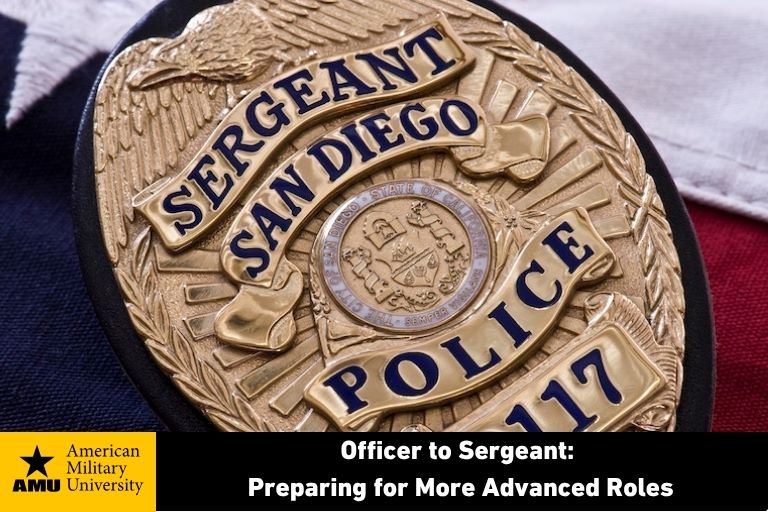
If you’re a police officer, deputy sheriff or trooper who’s ready to climb the ladder, this guide is for you.
At the beginning of your law enforcement career, your focus is on direct field operations rather than supervisory roles. It takes work to prepare yourself and demonstrate to your department that you’ve got what it takes for a supervisory role.
For many law enforcement agencies in the U.S., the first line of promotion – following ranks such as police officer II and master deputy – is to the rank of sergeant. Sergeants manage shift operations instead of working patrol or responding to calls for service.
According to Police1®, sergeants are supervisors who “act as liaisons between upper management and subordinates.” They frequently serve as the watch commander and senior lead officer at serious incidents and crime scenes.
What Do Police Sergeants Do?
Sergeants supervise the rank-and-file members of their department, such as patrol officers, and ensure adherence to department policies. They report directly to their division lieutenant and are responsible for a wide array of tasks:
- Managing shift operations
- Scheduling personnel, managing leave, and other administrative duties
- Overseeing the day-to-day operations of the unit
- Approving and maintaining various reports, including crime reports and other paperwork
- Evaluating employee job performance
- Taking corrective action for substandard performance of officers
This role requires a good command of agency policies, strong interpersonal skills, leadership, and effective communication.
How to Become a Police Sergeant
Qualifications to become a police sergeant vary from one department to another. For candidates to be eligible for promotion, most police departments typically require three to seven years as a certified law enforcement officer and a degree from an accredited college or university. Some agencies also require a comprehensive background check.
In general, the application process involves three steps:
- Submit an application and resume – Describe your job experience and accomplishments, education, and training, along with supporting documentation. The resume should highlight police work and service in any specialized units, awards, and investigative achievements.
- Pass a multi-part examination – This exam includes written questions on agency policies and procedures, training standards, and leadership.
- Complete an interview before a promotion board – The interviewers may ask questions about job performance, responses to different scenarios, supervisory responsibilities, and operational challenges.
The promotion board typically consists of higher-ranking leadership, such as lieutenants and captains. This board evaluates candidates on various criteria, including:
- Command presence
- Knowledge and experience
- Decision-making abilities
- Communication skills
- Professionalism
- Conflict-resolution skills
Candidates’ combined score on the application, resume, test, and interview determines who makes the eligibility list for promotion when a position becomes available. The highest-scoring individuals are usually promoted first.
An agency may award additional points for seniority and for a college education. Any specialized duties, such as working as a field training officer or a police detective, can help improve your likelihood of being eligible for promotion.
In addition, promotion boards look at other factors, such as:
- Excellent performance evaluations
- A clean disciplinary record
- Connections to the community
- Problem-solving abilities for navigating complex situations
- Flexibility and how you adapt to change
“Nowadays, it’s more than just your ability to handle yourself on the street, which was how it was back when I got started back in the ’80s. Things have changed and for the better,” says Dr. Chuck Russo, Department Chair of Criminal Justice at American Military University (AMU). “This job is so much more multidimensional than it ever was.”
Demonstrating trustworthiness and commitment to the organization are critical, adds Marine Corps veteran and Virginia Beach Sheriff Rocky Holcomb. Holcomb became Virginia Beach’s seventh sheriff in 2023 and originally entered the city's force as a deputy sheriff in 1991 with just a high school diploma. Over time, Holcomb worked his way up the ranks while studying to earn his bachelor’s degree in organizational leadership and management.
“Trust is huge. I have to trust you and want to empower you to solve problems,” Holcomb notes. “You’ve also got to commit to the organization. You’ve got to be the first one in the building and the last one to leave and be willing to take on new assignments, roles, and responsibilities.”
Tips to Prepare for the Transition from Officer to Sergeant
The earlier you start studying and preparing, the better, Dr. Russo advises. In his 26 years in law enforcement, he has participated in both sides of the promotion process.
The first step is to start reading your agency’s standard operating procedures and recommended reading list, if any. It’s also a good idea to pick up management and leadership textbooks, which may be available in your police station’s library.
“Start studying, start preparing, because it is very, very competitive, especially at large agencies.” Dr. Russo says. “You have to do well on that written exam. That’s going to be how you make it to your next step.”
Dr. Russo also recommends joining a study group with other officers to quiz each other, take practice exams, and rehearse for the oral interview. Start practicing mock interviews a few months ahead of applying to become a sergeant and ask for honest feedback.
“Other officers are your competition to a degree, but there’s usually going to be more than one promotion from the promotion list,” Dr. Russo adds. “It’s worth working together with others because it will help you with those follow-up questions and seeing things that maybe you didn’t see when you’re just reading or studying on your own. It’s really a big help and I definitely encourage that.”
Passing the Board Interview
Successful completion of the board interview can make or break your chances for promotion from officer to sergeant. You’ll have to demonstrate your mastery of department policies but also how you would apply it in real life, Dr. Russo notes.
“An individual can show a little bit of his or her personality style and leadership ability by framing the answer in certain ways,” Dr. Russo says. “Those candidates are the ones who may set themselves apart to the people issuing the grades and scores.”
Demonstrating your personality and leadership style matters when a promotion board conducts dozens of interviews, which is common at large police departments and sheriff’s departments. Show that you can do more than routine police work that involves enforcing laws, solving robberies, or serving on highway patrol. Show that you can lead your organization and handle future challenges.
Training to Go from an Officer to Sergeant
The promotion list is typically good for a certain period, such as one to two years, Dr. Russo says. Selected officers may undergo a probational period after being promoted to sergeant.
After promotion, your agency should provide you with training to prepare you for your new role and responsibilities. This training can be in the form of a leadership course, sergeant candidate school, or both.
A popular option is the two-week Leadership in Police Organizations (LPO) course through the International Association of Chiefs of Police® (IACP®). This course is based on the concept of dispersed leadership (“every officer a leader”).
According to the IACP, this course prepares you to take on a leadership role and covers various concepts, including how to:
- “Understand and apply modern behavioral science and leadership theories that affect human motivation, satisfaction, and performance in the achievement of organizational goals
- Employ frameworks to translate your knowledge and experience into effective leadership actions
- Integrate course content into your daily leadership practices
- Inspire a lifelong commitment to the study and practice of effective leadership”
Seeking More Advanced Roles after Becoming a Sergeant
If you want to ascend to a higher level of leadership, becoming a sergeant is just the beginning. The next promotion from sergeant is typically to lieutenant and captain.
Those positions are followed by other ranks such as:
- Lieutenant colonel
- Division chief
- Deputy chief
- Assistant sheriff
Chief of police and sheriff are the highest-ranking commanding officers in a department. They are appointed and elected positions, respectively.
Continuing Education Is Essential
At all levels, continuous training and education are critical to becoming an effective leader.
There are numerous educational options dedicated to improving your leadership abilities. The FBI National Academy Associates is a nonprofit that offers a leadership certification program. There are also the courses offered through the IACP and state police chief associations.
Some law enforcement officers choose to pursue a particular area of specialization, such as:
- Counterintelligence
- Cybercrime
- Digital forensics
- Law enforcement leadership
- Security management
“Never stop learning. It’s a lifelong journey,” Dr. Russo advises. “You’ve always got to be hungry, especially with this field. Between the court opinions and court cases, stuff changes by the moment that impacts not just you, but the people you supervise in a police department.”
Also, consider finding a mentor. Commanding officers may be willing to mentor you so you can learn from their experience.
The Role of Higher Education
Even if a college degree is not required by your police department or other law enforcement agency, it is a great way to prepare for promotion. A college degree increases your knowledge and helps you improve your writing, communication, and problem-solving skills, Dr. Russo says.
“Going for that degree helps you improve the skillset that will then help you with what comes along with being a supervisor. You’ll be dealing with supervising individuals, working with the general public, and solving problems that are different than the problems that you encountered as a police officer,” Dr. Russo says. “It’s a different set of skills; it’s a different type of problem solving when you make that step into the supervisory capacity for an agency.”
Promotion boards can tell which candidates have invested in their education, he adds. “A college degree signals to the agency that you’ve taken it upon yourself to improve your knowledge, skills, and abilities, your public speaking capabilities, and your communication skills. "
"That’s really one of the keys,” Dr. Russo says. “That shows when we get these individuals in these boards, in these exams, going for promotion, we can tell. They present a little differently when they’re in these settings, and it’s for the right reasons.”
The Bachelor’s Degree in Criminal Justice at AMU
For police officers and others seeking to upskill their knowledge and abilities, AMU provides an online Bachelor of Arts in Criminal Justice. For this degree program, students can enroll in courses such as U.S. law enforcement, criminology, criminal investigation, and the criminal legal process. Other courses include constitutional law, criminal law, and corrections and incarceration.
This degree program also provides four concentrations so that students can tailor their education to meet their professional goals. These concentrations include:
- General
- Entrepreneurship
- Maritime law enforcement
- Organizational law enforcement leadership
Classes are online and typically run for eight weeks, with no set login times. That flexibility makes it easier for police officers to plan their studies around work shifts and family.
AMU also prioritizes affordability so that police officers can pursue their education without undue financial stress. AMU provides the Everyday Heroes Grant, a 20% tuition discount for law enforcement and other public safety professionals. AMU also offers:
- $0 ebooks for students at all levels
- $0 application fee for undergraduate and graduate programs
- $0 transfer credit evaluation
- No entrance exam
At AMU, police officers may also receive academic credit for job experience, prior academic coursework, and law enforcement training. That includes:
- Basic Law Enforcement Training (BLET)
- Police Officer Standards and Training (POST)
- Federal Law Enforcement Training Accreditation (FLETA)
For more details, visit AMU’s criminal justice degree program page.
Police1® is a registered trademark of The Praetorian Group.
International Association of Chiefs of Police® and IACP® are registered trademarks of the International Association of Chiefs of Police.
Note: This program is not designed to meet the educational requirements for professional licensure or certification in any state. These programs have not been approved by any state professional licensing body and do not lead to any state-issued professional license.